Three quotes that defined The Future of German Media 2026
Twipe Insights
In a somewhat ironic twist, The Future of German Media summit took place in the old, repurposed MADSACK printing house in Hanover last week.
Over two days, 700 editors, publishers, product leads, and executives from news organizations across Germany filled it to talk about what comes next.
It’s a conference that happens almost entirely in German, which means most of the non-German-speaking publishing world never hears about it. We were there and wanted to share the three quotes worth crossing the language barrier for.
"The next three to five years will determine the next three to five decades in journalism."
- Thomas Düffert, CEO, MADSACK Mediengruppe
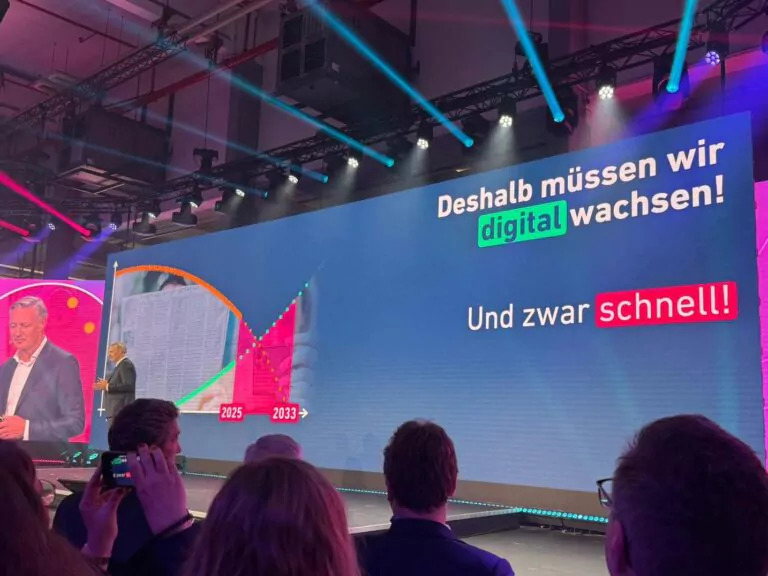
Düffert opened with a chart projected on the large LED screen dominating the stage: one line tracing the steady decline of print revenues, the other the rise of digital. They intersected somewhere around 2030.
Digital is growing, he said, “but not as fast as the print business is declining.” Print won’t disappear entirely, but it will no longer be enough to sustain journalism on its own.
The window to build viable digital business models is open now. “It’s crunch time,” he said. “The next three to five years will determine the next three to five decades in journalism.”
The shift that matters is from ‘AI in media’ to ‘media in AI.’
- Ezra Eeman, Strategy and Innovation Director, NPO
Eeman, who leads the WAN-IFRA AI in Media initiative and writes the Wayfinder newsletter on media innovation, used his session to reframe a conversation the industry has been having for the past two years.
Most publishers, he noted, have focused on how to integrate AI into their workflows (e.g., automating routine content, speeding up production, reducing costs). It’s certainly important work, but ultimately secondary. “The question is no longer how to put AI into your media,” he said. “It’s how to put your media into AI.”
AI systems are increasingly becoming the first point of contact between audiences and information. Which shifts the strategic focus: it’s no longer just about what AI can do inside the newsroom, but where, how, and under what conditions journalism appears within AI-driven environments. Publishers who haven’t started thinking in those terms are already behind — even if their internal AI tooling is strong.
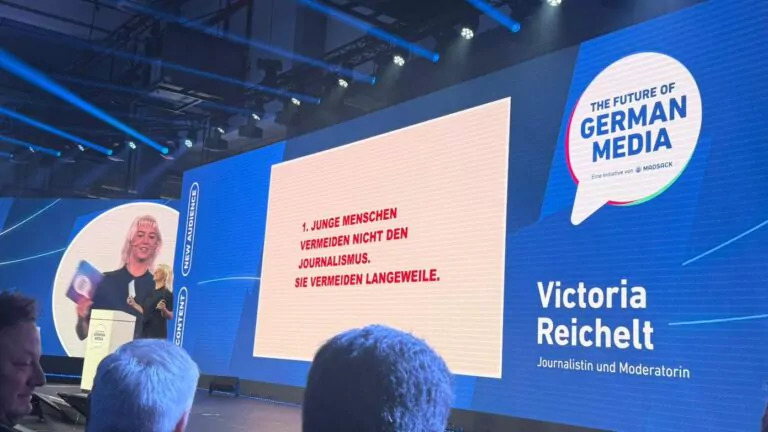
"Young people don’t avoid journalism. They avoid boredom."
- Victoria Reichelt, journalist and moderator, ARD/ZDF Funk
Reichelt co-moderated the main stage and works on Funk, the ARD/ZDF platform aimed at younger audiences. She has built a substantial direct following by explaining politics to people who are supposed to have tuned out.
The assumption that younger audiences are disengaged from politics is wrong. They engage with high-stakes political content all the time. What they don’t do is sit through formats that feel slow, closed, or disconnected from how they actually live. The problem isn’t the subject matter, but how it’s packaged.
Sarah Cool-Fergus is Media Insights Writer & Business Analyst at Twipe.
First published in Twipe's blog