The state of the news industry in 2026
Twipe explains the analysis of Reuters Institute in 7 graphs
Every year, we look forward to the latest Trends and Predictions Report from the Reuters Institute for the Study of Journalism.
Drawing on the views of more than 280 media leaders worldwide, the report offers a snapshot of how the industry sees the year ahead.
In this article, we’ve picked out seven graphs that best capture the opportunities and tensions facing news organizations in 2026.
Curious how this year’s data compares to that of previous reports? Read our 2025 and 2024 articles.
The confidence gap
This year’s report highlights a gap between how media leaders feel about their own organizations versus the industry at large.
Around half (53%) of leaders are confident in their own business prospects for the year ahead. In contrast, only 38% are confident about the prospects for journalism as a whole, “down 22pp from the figure in [Reuters’] 2022 poll.”
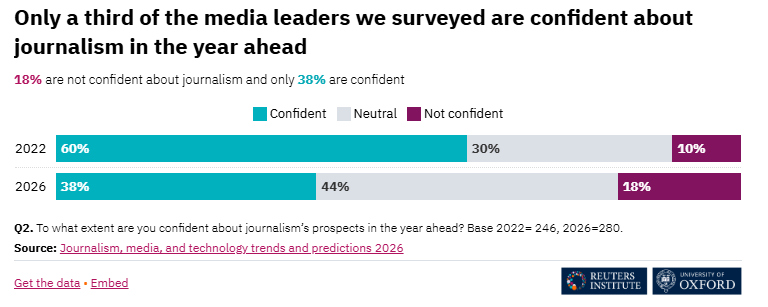
This paradox (confidence in the individual, pessimism about the collective) reveals deeper anxieties about systemic threats on the horizon: the impact of AI, a growing sense of being out-competed by the creator industry, and the rise of politically motivated attacks designed to undermine the press, among others.
Audience relationships take priority
Despite the challenges, the importance of building a direct relationship with the audience itself remains a central priority. When asked about their most important revenue streams for 2026, publishers ranked their priorities as follows:
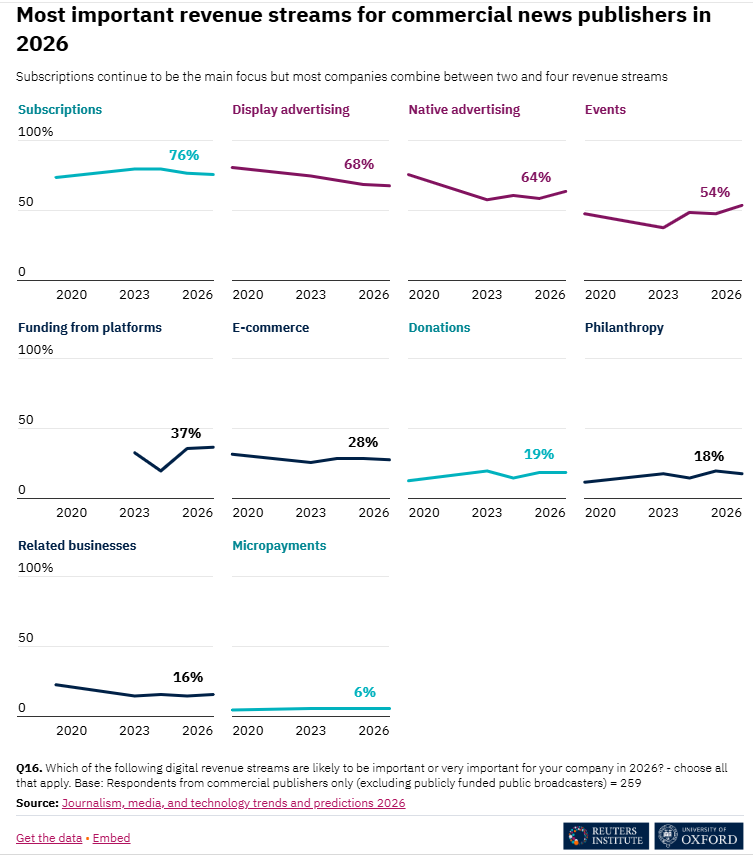
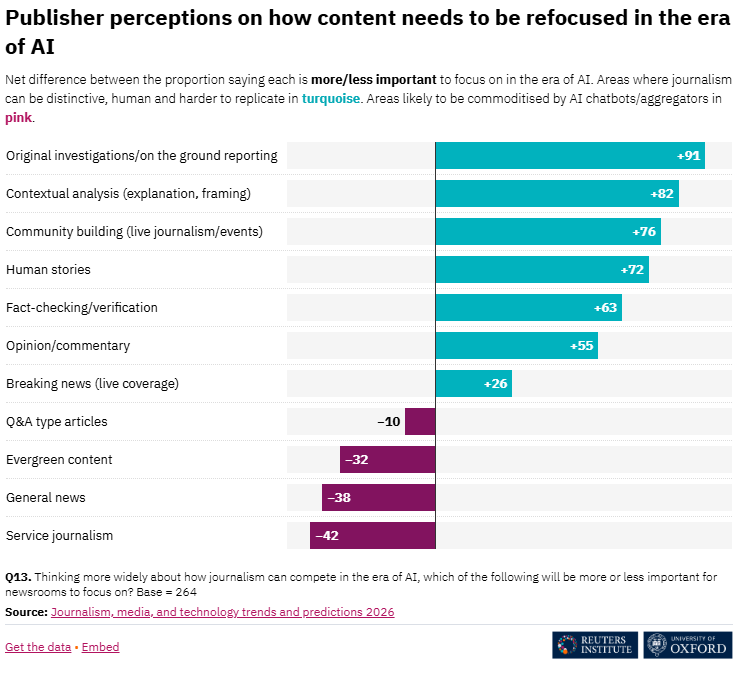
The dominance of subscriptions and events demonstrates a strategic commitment to building loyal communities. To support this, publishers are doubling down on content that is uniquely human, moving away from easily automated formats such as service journalism and generic news briefs in favour of exclusive reporting, deep analysis, compelling storytelling, as well as engaging formats like audio and video that machines still struggle to replicate well.
From search traffic to brand destination
For years, search engines have been a large source of audience acquisition for publishers, but the rise of AI threatens to turn that firehose into a trickle.
On average, publishers anticipate traffic from search engines to decline by more than 40% over the next three years. Supporting data from analytics provider Chartbeat shows that Google traffic from organic search to over 2,500 sites was down 33% globally between November 2024 and November 2025.
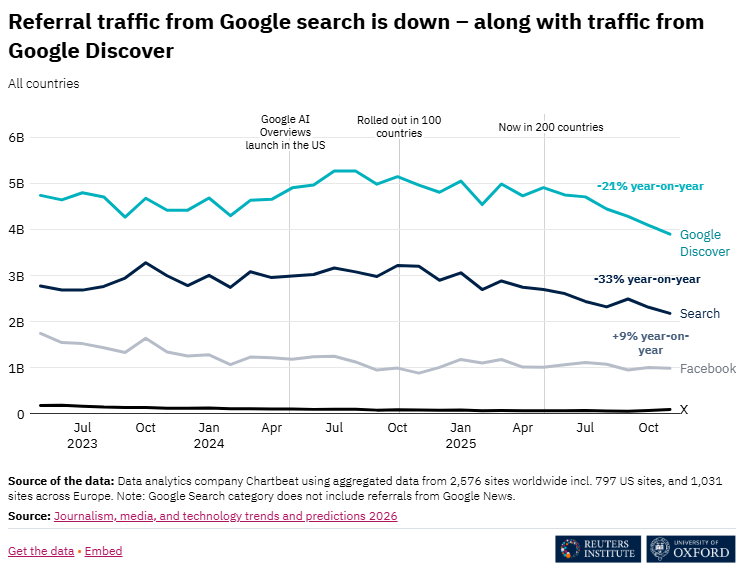
The user’s journey, which once ended on a publisher’s website, may now conclude within a chatbot’s summary off platform, with the original source relegated to a small citation, if it appears at all. This forces a strategic shift from an audience acquisition mindset to a brand destination mindset.
The creator dilemma
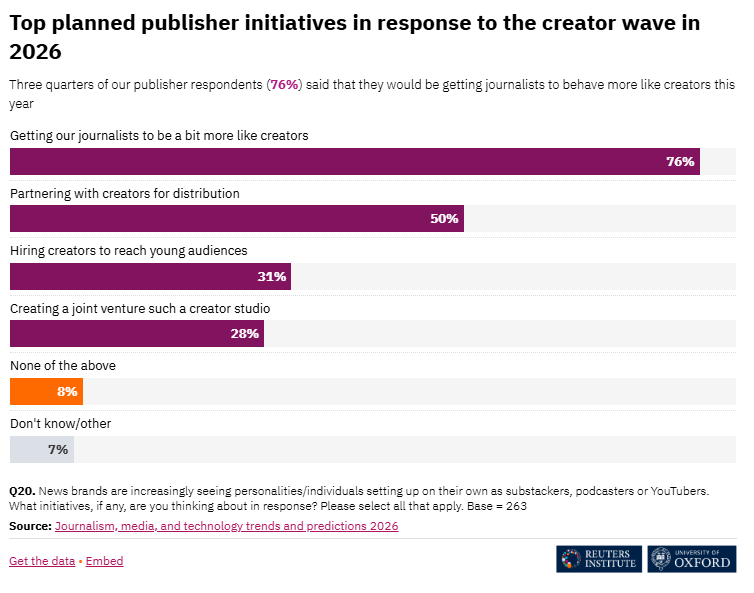
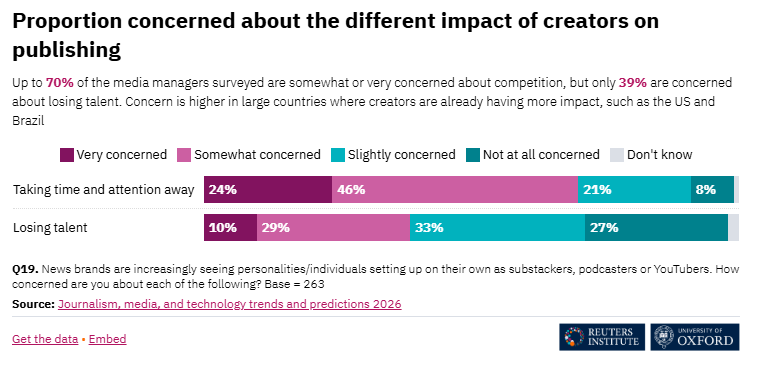
Reuters Trends and Predictions 2026 report highlights publishers’ view that creator economy presents a double-edged sword for news organizations. Publishers are actively encouraging their journalists to become “platform personalities,” yet this strategy comes with the significant risk of creating their own biggest competitors.
A case study from the report illustrates this talent drain. Dave Jorgenson, “the Washington Post TikTok guy,” worked at the company for eight years, building a massive following under its brand. After he left to start his own independent YouTube channel, he effectively took his audience with him, leading to a decline in the Post’s own channel.
This story visualizes the dilemma facing the industry. It gives life to the tension between the 76% of publishers who plan to get their staff to act more like creators in 2026 and the 39% who fear losing top editorial talent to the creator ecosystem.
Why execution is the real challenge
External threats like AI and platform shifts are only half the battle. The most formidable obstacles to progress are often internal, rooted in a company’s resources, skills, and organizational culture. When news leaders were asked to identify the biggest barriers to innovation, the answers pointed inward.
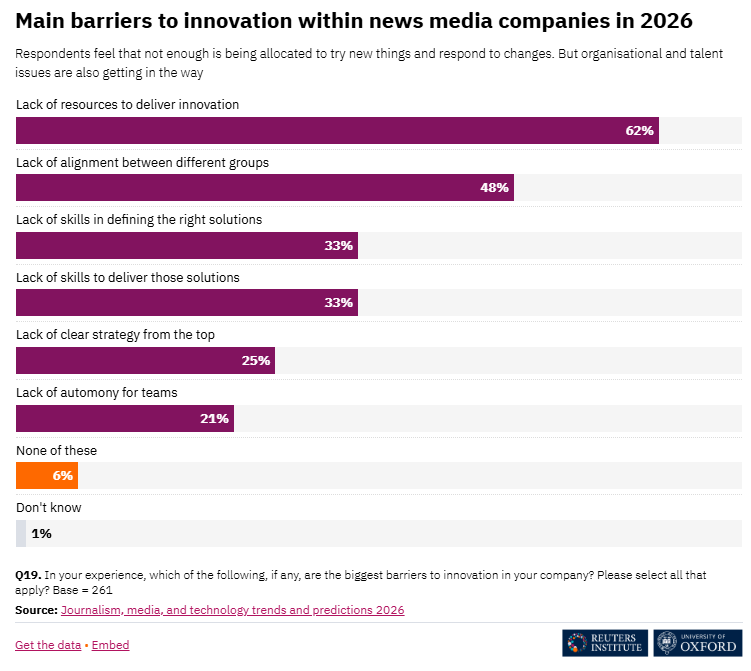
Ultimately, the biggest differentiator may not be vision, but leadership’s ability to translate ambition into action across people, processes, and culture.
Conclusion
Taken together, this year’s predictions paint a more subdued picture than in previous reports, reflecting the broader dip in confidence felt across the news industry. Yet the data also points to areas of clarity: publishers are doubling down on direct audience relationships. While the year ahead remains unpredictable, content focus, human differentiation, and community building continue to stand out as the most reliable paths forward.
Sarah Cool-Fergus is Media Insights Writer & Business Analyst at Twipe.
First published in Twipe's blog